

One of the biggest mistakes students make is assuming that attending lectures automatically guarantees understanding.
The truth is that many students sit through hours of lectures, fill several notebooks, and still struggle to remember key concepts during exams.
Why?
Because taking notes and taking effective notes are two completely different things.
Smart note-taking is one of the most powerful academic skills a student can develop. Good notes help you understand lessons better, remember information longer, revise faster, and perform more confidently in examinations.
In this guide, you’ll learn how to take lecture notes like a top-performing student and turn every lecture into an opportunity for academic success.
Why Note-Taking Is Important
Many students underestimate the value of quality notes.
Effective notes serve as:
- A personal learning resource
- A revision guide
- A memory aid
- A summary of important concepts
- A tool for exam preparation
Research shows that students who take organized notes tend to retain information better than those who simply listen during lectures.
Writing information down forces your brain to process and organize ideas, improving understanding and memory.
Common Note-Taking Mistakes Students Make
Before learning effective techniques, it’s important to identify what many students do wrong.
Writing Every Word
Some students try to copy everything the lecturer says.
This often leads to:
- Missing important explanations
- Poor concentration
- Disorganized notes
Your goal is to understand, not become a transcription machine.
Taking Notes Without Understanding
Many students fill pages with information they don’t actually understand.
Good notes should make concepts clearer, not more confusing.
Never Reviewing Notes
Taking notes is only the first step.
Students who never revisit their notes often forget most of what they learned within days.
Poor Organization
Random notes scattered across notebooks make revision stressful.
A lack of structure can make finding information difficult during exam preparation.
Prepare Before the Lecture
Great notes begin before the lecturer enters the classroom.
Read Ahead
Spend 10–15 minutes reviewing the upcoming topic.
This helps you:
- Understand concepts faster
- Identify important points
- Follow lectures more easily
Even a quick overview can significantly improve comprehension.
Bring the Right Materials
Ensure you have:
✔ Notebook
✔ Pen and highlighter
✔ Laptop or tablet (if allowed)
✔ Previous lecture notes
✔ Course outline
Being prepared helps you stay focused.
What Information Should You Write Down?
Not everything said during a lecture belongs in your notebook.
Focus on recording:
Definitions
Definitions are often tested in examinations.
For example:
Inflation: A sustained increase in the general price level of goods and services over time.
Key Concepts
Record major ideas and theories discussed during class.
Formulas
For quantitative courses such as:
- Mathematics
- Statistics
- Accounting
- Economics
- Physics
Keep formulas clearly separated for easy revision.
Examples
Examples often simplify complex concepts.
Write down practical illustrations provided by the lecturer.
Lecturer Emphasis
Pay special attention when lecturers say:
- “This is important.”
- “This may come out in exams.”
- “Take note of this.”
These are valuable clues.
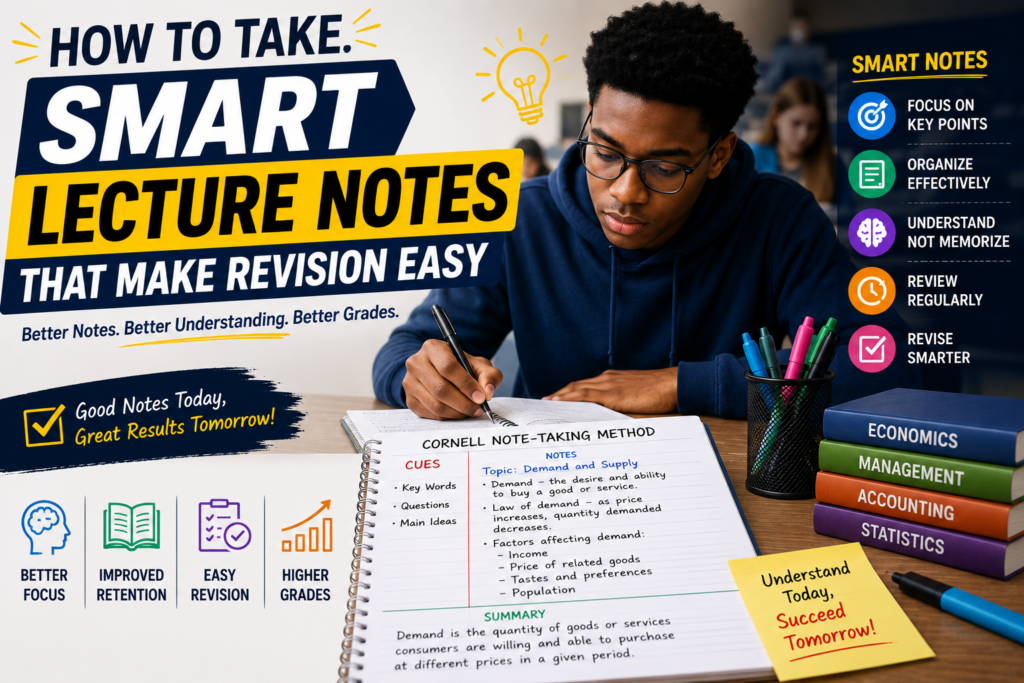
The Cornell Note-Taking Method
One of the most effective note-taking systems is the Cornell Method.
Divide your page into three sections.
Main Notes Section
Use the largest section to record lecture information.
Example:
Topic: Demand and Supply
- Meaning of demand
- Factors affecting demand
- Law of demand
- Exceptions to demand
Cue Column
Write keywords or questions.
Example:
- What is demand?
- What causes demand shifts?
- Explain the law of demand.
These questions become excellent revision tools later.
Summary Section
At the bottom of the page, summarize the lecture in a few sentences.
Example:
Demand refers to consumers’ willingness and ability to purchase goods at different prices. Demand generally decreases as price increases.
This summary helps reinforce learning.
Use Abbreviations and Symbols
Speed matters during lectures.
Create shortcuts such as:
| Symbol | Meaning |
|---|---|
| ↑ | Increase |
| ↓ | Decrease |
| → | Leads to |
| = | Equals |
| b/c | Because |
| e.g. | Example |
| w/ | With |
| vs | Versus |
Using abbreviations allows you to capture information quickly without missing important explanations.
Make Your Notes Visual
Your brain remembers visuals better than large blocks of text.
Use:
Bullet Points
Instead of:
Demand is influenced by income levels, consumer tastes, population growth, and prices of related goods.
Write:
Factors Affecting Demand
- Income
- Consumer preferences
- Population
- Related goods
Headings and Subheadings
Organize information clearly.
Example:
Inflation
- Definition
- Causes
- Effects
- Control Measures
Mind Maps
Mind maps are excellent for theory-based subjects.
Place the main topic in the center and create branches for related concepts.
This improves understanding and memory retention.
Take Notes Digitally or By Hand?
Students often ask which method is better.
Handwritten Notes
Advantages:
- Better memory retention
- Fewer distractions
- Improved understanding
Digital Notes
Advantages:
- Faster typing
- Easy organization
- Searchable content
- Cloud storage
Choose the method that suits your learning style.
Many successful students combine both approaches.
Review Notes Within 24 Hours
One of the biggest secrets of top-performing students is immediate review.
Research suggests that people forget a large portion of new information within 24 hours if they do not review it.
After class:
- Read through your notes
- Fill missing gaps
- Clarify confusing points
- Highlight important information
This simple habit dramatically improves retention.
Turn Notes Into Revision Materials
Your notes should eventually become study resources.
Convert them into:
Flashcards
Ideal for:
- Definitions
- Formulas
- Key concepts
Summary Sheets
Condense entire chapters into one page.
Perfect for exam revision.
Practice Questions
Create possible exam questions from your notes.
For example:
Explain three causes of inflation.
State and explain the law of demand.
Testing yourself strengthens memory.
How Top Students Use Their Notes
Successful students don’t just collect notes.
They actively use them.
Their process typically looks like this:
- Attend lecture
- Take organized notes
- Review within 24 hours
- Create summaries
- Practice questions
- Revise regularly
This cycle improves understanding and reduces exam stress.
The Best Note-Taking Apps for Students
Several digital tools can enhance note-taking.
Microsoft OneNote
Excellent for organizing lecture notes.
Notion AI
Combines notes, planning, and AI-powered summaries.
Evernote
Useful for storing and organizing information.
Google Keep
Simple note-taking and reminders.
Otter.ai
Generates lecture transcripts automatically.
Final Thoughts
Smart note-taking is more than simply writing things down—it’s about capturing information in a way that makes learning, understanding, and revision easier.
When done correctly, effective lecture notes can become one of the most valuable academic tools in your arsenal. By organizing information clearly, reviewing regularly, and transforming notes into revision materials, students can improve memory retention, reduce exam anxiety, and achieve better academic results.
Remember: The quality of your notes often determines the quality of your revision, and the quality of your revision often determines your exam performance.