

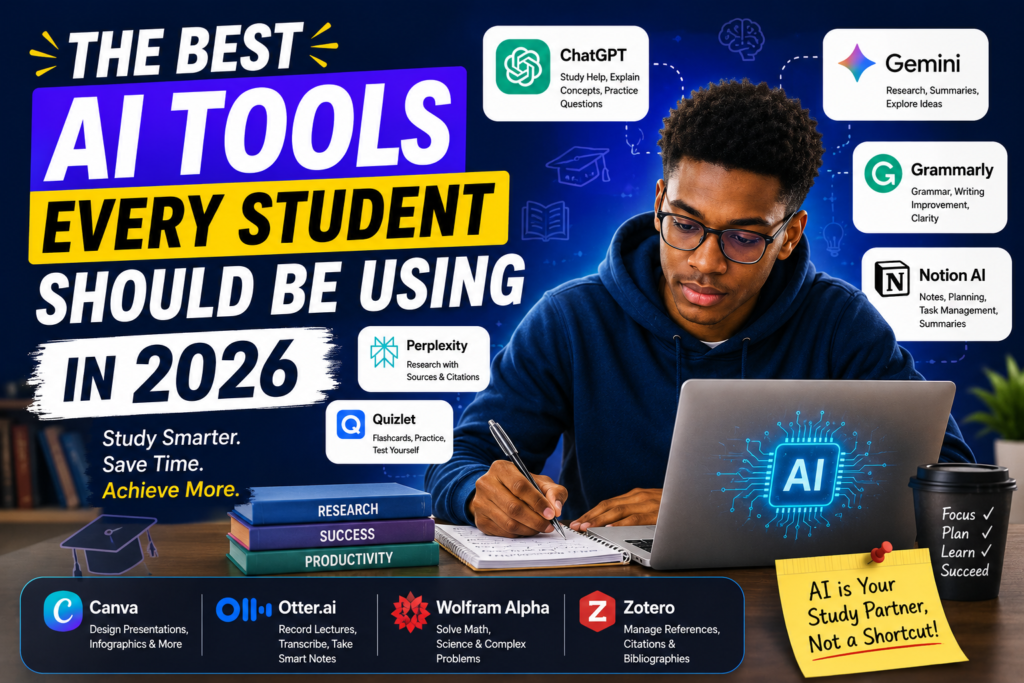
Artificial Intelligence (AI) is no longer a futuristic concept—it has become an essential part of modern education. From helping students understand difficult concepts to organizing study schedules and conducting research, AI is transforming the way people learn.
Today’s students have access to powerful tools that can make studying faster, easier, and more effective. Whether you’re preparing for examinations, writing assignments, conducting research, or managing multiple courses, AI can help you work smarter and achieve better academic results.
In this guide, we’ll explore the best AI tools every student should be using in 2026 and how they can enhance learning and productivity.
Why AI Matters in Education
The educational landscape is evolving rapidly.
Students today face numerous challenges:
- Heavy academic workloads
- Multiple assignments
- Tight deadlines
- Information overload
- Research-intensive projects
AI helps solve many of these problems by providing instant assistance, personalized learning experiences, and improved productivity.
Benefits of AI for students include:
✔ Faster learning
✔ Better understanding of complex topics
✔ Improved time management
✔ Enhanced research capabilities
✔ Stronger writing skills
✔ Increased productivity
However, AI should be used as a learning companion—not a replacement for critical thinking and independent study.
1. ChatGPT
Your Personal AI Study Assistant
ChatGPT has become one of the most popular educational tools worldwide.
Students can use it to:
- Understand difficult concepts
- Summarize lengthy chapters
- Generate study plans
- Create revision notes
- Practice exam questions
- Improve academic writing
Example Uses
Instead of reading a 20-page chapter repeatedly, a student can ask:
“Explain the concept of inflation in simple terms.”
Or:
“Create 20 practice questions from this chapter.”
ChatGPT can provide instant explanations and help simplify complex subjects.
Best For
- Exam preparation
- Concept explanations
- Assignment support
- Study planning
- Revision
2. Google Gemini
Powerful Research and Information Discovery
Google Gemini is particularly useful for students conducting academic research.
It can:
- Analyze information quickly
- Generate summaries
- Explain academic topics
- Brainstorm ideas
- Assist with project work
Because Gemini is integrated with Google’s ecosystem, it can help students work efficiently across multiple platforms.
Best For
- Research projects
- Information gathering
- Brainstorming
- Academic exploration
3. Grammarly
Improve Your Writing Instantly
Strong writing skills are essential for academic success.
Whether you’re writing:
- Essays
- Reports
- Research papers
- Assignments
- Seminar presentations
Grammarly helps identify:
- Grammar mistakes
- Spelling errors
- Punctuation issues
- Clarity problems
- Sentence structure weaknesses
Why Students Love Grammarly
It acts like a personal editor, helping students submit cleaner and more professional work.
Many students lose marks because of avoidable writing mistakes. Grammarly helps reduce those errors significantly.
Best For
- Academic writing
- Assignment submission
- Essay improvement
- Professional communication
4. Notion AI
The Ultimate Student Productivity Tool
Notion AI combines note-taking, task management, and AI-powered assistance in one platform.
Students can use it to:
- Organize lecture notes
- Create study schedules
- Track assignments
- Manage projects
- Generate summaries
Imagine having all your courses, notes, assignments, and deadlines organized in one digital workspace.
That’s exactly what Notion AI provides.
Best For
- Academic organization
- Project management
- Study planning
- Course management
5. Perplexity AI
Research With Sources
One major challenge with AI tools is verifying information.
Perplexity solves this problem by providing citations and sources alongside its answers.
Students can:
- Conduct research
- Verify information
- Explore academic topics
- Find supporting materials
This makes it particularly useful for university students working on projects and research papers.
Best For
- Academic research
- Fact-checking
- Literature reviews
- Source discovery
6. Quizlet
Master Exam Preparation
Quizlet uses flashcards and interactive learning methods to improve memory retention.
Students can:
- Create custom flashcards
- Study definitions
- Test themselves
- Practice active recall
Quizlet is especially useful for courses requiring extensive memorization.
Best For
- Medical students
- Law students
- Language learners
- Examination revision
7. Canva
Design Better Presentations and Projects
Many academic projects require visual presentations.
Canva allows students to create:
- Presentation slides
- Infographics
- Posters
- Research visuals
- Social media graphics
Its AI-powered features make designing easier, even for beginners.
Best For
- Presentations
- Seminar projects
- Visual assignments
- Academic posters
8. Otter.ai
Turn Lectures Into Notes Automatically
Imagine attending a lecture without worrying about writing every word.
Otter.ai can:
- Record lectures
- Generate transcripts
- Create searchable notes
- Capture important discussions
Students can focus more on understanding and less on frantic note-taking.
Best For
- Lecture recording
- Interview documentation
- Seminar note-taking
9. Wolfram Alpha
The AI Tool for Mathematics and Science
Students studying:
- Mathematics
- Physics
- Engineering
- Statistics
can use Wolfram Alpha to solve complex problems and understand step-by-step solutions.
It is one of the most powerful educational tools available for quantitative subjects.
Best For
- Problem solving
- Mathematical calculations
- Scientific analysis
10. Zotero
Simplify Research and Referencing
One of the most frustrating parts of academic writing is citation and referencing.
Zotero helps students:
- Collect research materials
- Organize references
- Generate citations automatically
- Manage bibliographies
This saves countless hours during project writing.
Best For
- Research papers
- Final-year projects
- Academic writing
- Thesis preparation
How Students Can Use AI Responsibly
While AI offers incredible benefits, students should avoid overdependence.
Follow these best practices:
Use AI to Learn, Not Cheat
AI should help you understand concepts rather than complete assignments without learning.
Verify Information
Always cross-check important information using textbooks, journals, and lecturer-approved resources.
Avoid Plagiarism
Never submit AI-generated content without reviewing and modifying it.
Develop Independent Thinking
AI should support your learning process—not replace critical thinking.
The Future of AI in Education
Experts predict that AI will continue transforming education through:
- Personalized learning experiences
- Smart tutoring systems
- Automated feedback
- Virtual classrooms
- Adaptive learning technologies
Students who learn to use AI effectively today will have a significant advantage in the future academic and professional world.
Final Thoughts
Artificial Intelligence is changing the way students learn, study, and succeed academically. From understanding difficult concepts to conducting research and organizing coursework, AI tools can dramatically improve productivity and learning outcomes.
The key is to use these tools wisely. When combined with discipline, critical thinking, and consistent study habits, AI can become one of the most powerful educational resources available to students.
Whether you’re preparing for exams, writing assignments, conducting research, or managing your academic workload, these AI tools can help you study smarter, save time, and achieve greater success.