

Introduction
The semester seemed long enough. You promised yourself that you would start reading early. Yet somehow, exams are now only a few days away, and an entire course remains untouched.
The good news is that all hope is not lost.
While covering a full semester course in one week is not ideal, it is absolutely possible to understand the most important concepts, retain key information, and perform well in your examinations if you use the right approach.
This guide will show you exactly how to study an entire semester course in seven days without feeling overwhelmed.
First, Accept One Important Reality
If you have only one week left, your goal is not to become an expert in every chapter.
Your goal is to:
- Understand major concepts
- Master frequently tested topics
- Learn key definitions and principles
- Practice likely examination questions
- Maximize your available time
Trying to read every word of every page may leave you exhausted and confused.
Instead, focus on studying strategically.
Day 1: Understand the Course Structure
Before opening your textbook, spend 30–60 minutes understanding the course itself.
Ask yourself:
- How many topics are covered?
- Which topics are most important?
- Which areas appear frequently in past questions?
- What areas did the lecturer emphasize during lectures?
Gather all available materials:
✔ Lecture notes
✔ Textbooks
✔ Handouts
✔ PowerPoint slides
✔ Past questions
✔ Assignment questions
✔ Recommended reading materials
Once you have everything in one place, create a list of all topics.
This gives you a clear roadmap and prevents panic.
Identify High-Yield Topics
One of the biggest mistakes students make is treating all topics equally.
In reality, some topics are tested more frequently than others.
Look for:
Frequently Repeated Topics
Check past questions from previous years.
If a topic appears repeatedly, it deserves extra attention.
Lecturer’s Favorite Topics
Most lecturers emphasize certain concepts throughout the semester.
Pay attention to:
- Topics explained multiple times
- Areas highlighted during lectures
- Topics used for assignments and tests
Core Concepts
Some topics form the foundation for understanding the entire course.
Master these first.
For example:
In Economics:
- Demand and Supply
- Market Structures
- Inflation
In Statistics:
- Mean
- Variance
- Probability
In Accounting:
- Double Entry Principles
- Ledger Accounts
- Financial Statements
Understanding foundational concepts makes advanced topics easier.
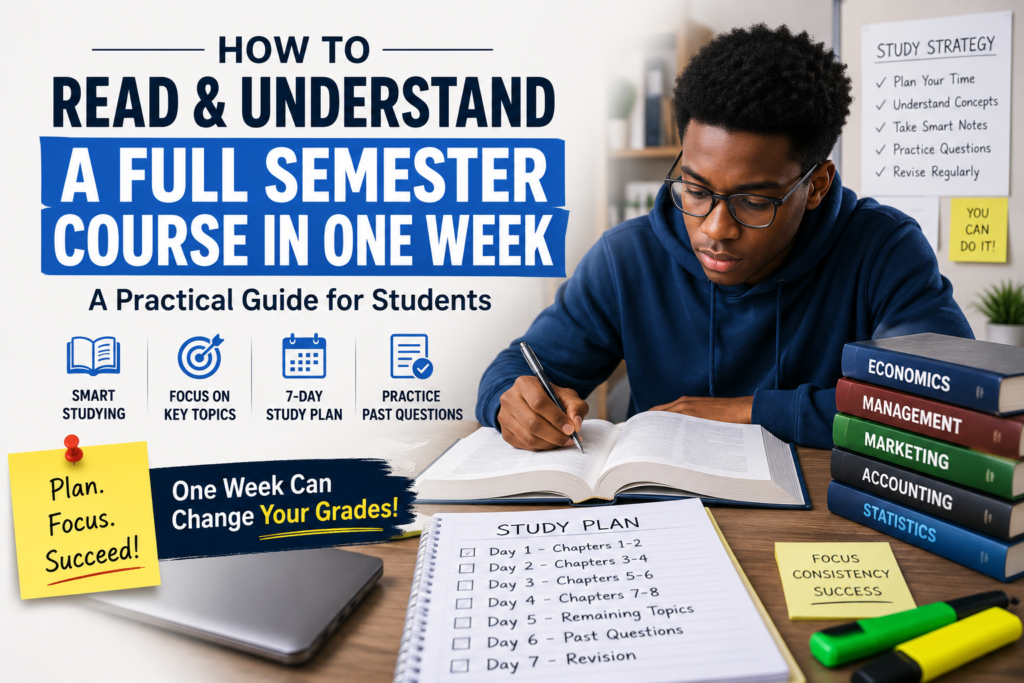
Create a Realistic Seven-Day Study Plan
Without a timetable, you may waste valuable hours deciding what to study next.
Divide the course into manageable sections.
Example Study Schedule
Day 1
- Course overview
- Chapters 1–2
Day 2
- Chapters 3–4
Day 3
- Chapters 5–6
Day 4
- Chapters 7–8
Day 5
- Complete remaining topics
Day 6
- Practice past questions
Day 7
- Revision and weak areas
Avoid creating unrealistic schedules.
A practical plan is better than an ambitious one you cannot follow.
Use the 80/20 Rule
The 80/20 Principle suggests that approximately 80% of exam questions often come from 20% of the course content.
Focus on:
- Important definitions
- Key theories
- Major formulas
- Frequently tested concepts
This strategy helps maximize exam performance within limited time.
Study Actively, Not Passively
Many students spend hours reading without truly understanding.
Passive reading often creates an illusion of learning.
Instead, use active learning methods.
Technique 1: Active Recall
After reading a section:
Close the book.
Try to explain the concept without looking at your notes.
Ask yourself:
- What did I just learn?
- Can I explain it simply?
- Can I write it from memory?
This method strengthens memory far more effectively than rereading.
Technique 2: Teach Someone Else
One of the fastest ways to understand a topic is to teach it.
Imagine you’re explaining it to:
- A friend
- A younger student
- A family member
If you cannot explain it simply, you probably don’t understand it fully.
Technique 3: Mind Mapping
Mind maps help connect ideas visually.
Place the main topic in the center and create branches for:
- Definitions
- Examples
- Advantages
- Disadvantages
- Applications
This method works especially well for theory-heavy courses.
Use the Pomodoro Study Method
Studying continuously for six hours is rarely productive.
Instead, use focused study intervals.
Pomodoro Technique
- Study for 25 minutes
- Take a 5-minute break
Repeat four times.
Then take a 20-minute break.
This improves concentration and prevents mental fatigue.
Learn How to Take Smart Notes
While studying, create condensed notes.
Avoid copying entire chapters.
Instead, write:
Definitions
Short and clear.
Key Points
Only the most important ideas.
Formulas
List formulas separately.
Examples
Include practical examples that aid understanding.
Your notes should become your final revision material.
Use Past Questions as a Study Tool
Past questions are one of the most powerful exam preparation resources.
They help you:
- Identify important topics
- Understand question patterns
- Improve speed
- Build confidence
As you solve questions, you’ll notice recurring themes.
Focus your revision around these patterns.
Avoid Common Study Mistakes
Many students fail not because they lack intelligence, but because they use ineffective study methods.
Avoid these mistakes:
Cramming Without Understanding
Memorization alone often fails in exams.
Focus on understanding concepts.
Multitasking
Avoid:
- Social media
- Watching videos
- Constant texting
Concentrate on one task at a time.
Skipping Difficult Topics
Many students ignore challenging chapters.
Unfortunately, examiners often love testing those areas.
Face difficult topics early.
Reading Without Testing Yourself
If you’re not testing your knowledge, you’re not measuring your understanding.
Take Care of Your Health
Your brain performs best when your body is healthy.
During your study week:
Sleep Well
Aim for at least 6–8 hours daily.
Sleep improves memory consolidation.
Stay Hydrated
Drink enough water throughout the day.
Eat Balanced Meals
Avoid excessive junk food.
Choose foods that provide steady energy.
Exercise Lightly
Even a short walk can improve concentration.
The Night Before the Exam
Do not attempt to learn new topics.
Instead:
✔ Review summaries
✔ Revise formulas
✔ Review key concepts
✔ Practice a few questions
✔ Get enough sleep
A well-rested mind performs better than an exhausted one.
Final Thoughts
Reading and understanding a full semester course in one week is not easy, but it is achievable with discipline, focus, and the right strategy.
Success comes from studying smart, not simply studying longer.
Prioritize important topics, use active recall, practice past questions, and revise consistently. By following these techniques, you can improve your understanding, reduce exam anxiety, and significantly increase your chances of academic success.
Remember: One focused week of strategic study can accomplish more than a month of distracted reading.